
OpenStack iconOpenStackIaaS

With our OpenStack you get a virtual data center where you are in full control of all your resources, this is Infrastructure as a Service.

OpenStack is our Infrastructure as a Service (IaaS). With this service you get a complete virtual data center where you choose how you want to set up your resources. Everything from networks, storage, firewalls and servers to encryption and operating systems are fully automated.

The platform is built to handle large data volumes and high requirements on security and availability. We offer one region here in Sweden that consists of three accessibility zones (AZ) which are three completely separate data centers located at disaster-safe distance from each other (20km).
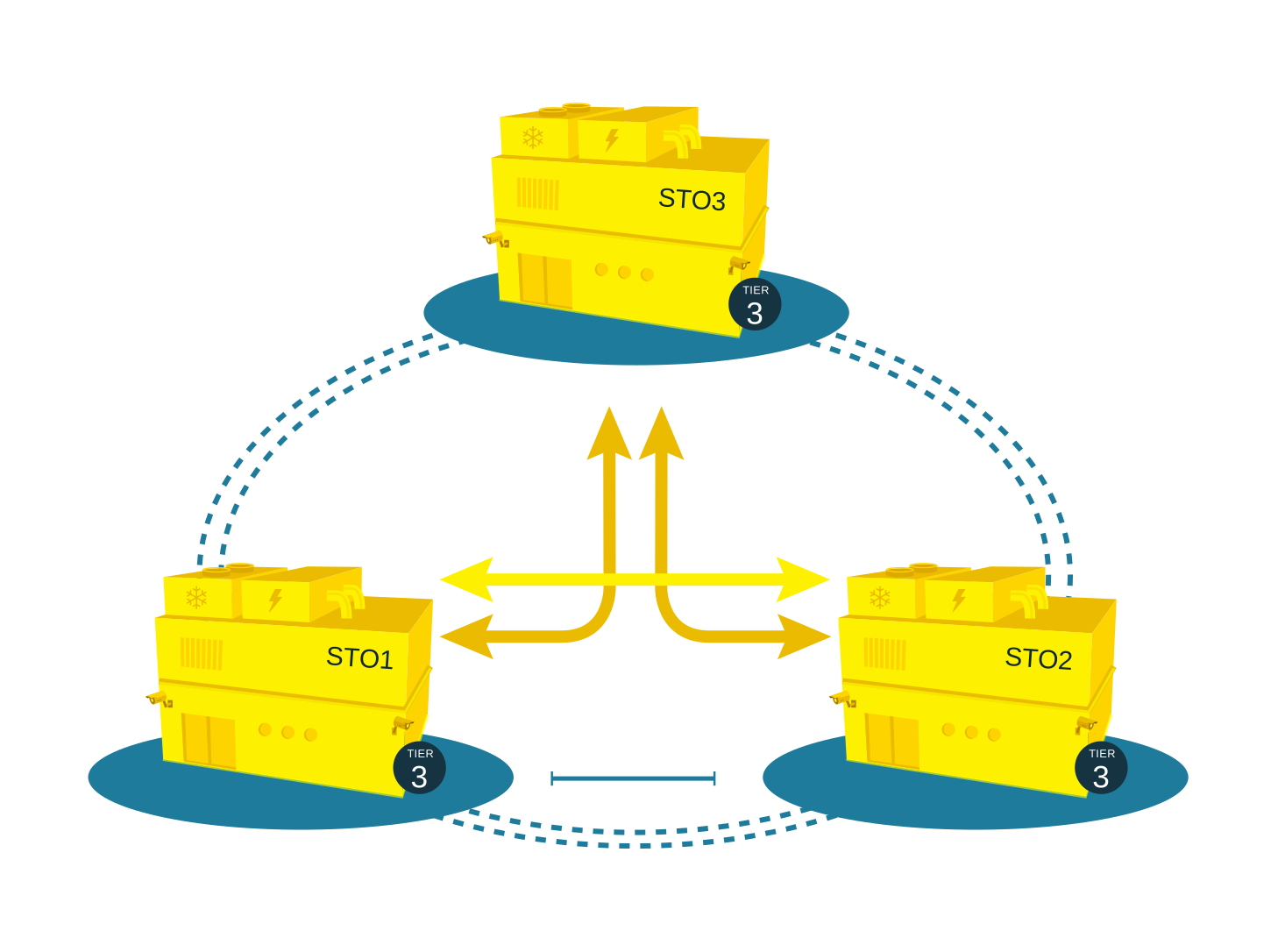
datacenter

We want our customers to take advantage of the redundancy that exists in the platform. By developing solutions that utilize all three availability zones our customers make a strategic choice to focus on security as well as availability.

Our OpenStack service is built with the open source project OpenStack which is a cloud operating system that manages large pools of computer, storage and network resources that are all managed and provided via APIs. Our OpenStack platform is tested and validated by the OpenStack foundation.

There are a large number of components in OpenStack and below we describe the ones that are available in our platform and how we have implemented them.

Computer Resources(Nova)

Nova handles all computer resources which in our case are virtual machines based on kvm and these machines are called Instances. There are a number of models of instances called Flavors. Flavors describe how much CPU memory and disk that an Instance gets as well as what type of hardware they are running on. Our standard Flavors are run on shared nodes and we have dedicated flavors that run on dedicated hardware for just that instance. When you create your instance, you can choose which availability zone to run in.

There are two different types of boot disks, either with a disk that is only called boot disk which runs on a local SSD disk on the server hardware where the instance is running or on a volume that runs on a central storage cluster. There are drawbacks and advantages to both types.

  • Boot disk is faster than volume.
  • Boot disk has a fixed size that cannot be changed (unless you change Flavor)
  • Volume can be redirected to other server hardware, which means that an instance can be moved at scheduled service windows or if a server hardware would break.

GPU

If you have Artificial Intelligence (AI), data analytics, or High Performance Computing (HPC) workloads, we have one GPU (Graphics Processing Unit) flavor that enable you to run these workloads quickly and efficiently. We utilize leading GPUs based on the NVIDIA Ampere architecture, designed to deliver high performance in data center environments.

Network(Neutron)

Neutron manages the network and firewalls. We have spent a lot of time on designing and building our network to make it redundant and scalable across our three data centers. One goal has been that traffic should always take the shortest route and not have to be sent back and forth between our data centers. We have solved this by using a fully distributed design for all network functions. NAT, firewall, DHCP and metadata are local to each server hardware and all routing is handled with anycast routing on the switch that is in the same rack where the instance is running.

In terms of capacity, we have at least 2x100Gb links between our switches and 2x10Gb or 2x25Gb to our servers. Between our data centers we have a high capacity and low delay fiber ring, 0.5ms round trip.

You create the necessary networks, subnets, routers and Security Groups (firewall rules) and you choose the addresses you want to use.

Disk image(Glance)

Glance handles disk images, operating system images are most common. We provide a number of different operating system images that are updated automatically once a month. If we do not provide an image for the operating system you want to use or want to build your own custom version, you can upload your own image. Glance stores its images in Swift.

Volume(Cinder)

Cinder handles storage volumes and you can connect one or more volumes to an instance. A Volume is a disk from a central storage cluster. We have one Storage Cluster per data center and when you map a Volume to an Instance the Volume and Instance must be running in the same availability zone.

We offer different volume types that control how fast a volume is. You can change the type and you can also resize an existing volume. For data protection, there are snapshots that store a copy of a volume in the same storage system and there are backups that take an image copy of the volume and store it in Glance. All volumes are encrypted at rest.

Object Storage(Swift)

Swift is an object storage service where you can store large amounts of data in a secure and cost-effective way. Ideal for images, documents, backups and other types of static files. An object uploaded in Swift is stored in three copies, one copy in each data center.

Secret Storage Service(Barbican)

Barbican is a service for storing and managing secrets. For example, a secret can be a certificate, an encryption key or a password. The secrets are encrypted using a HSM cluster that has a node in each data center. Other modules in OpenStack can use Barbican to store secrets. For example, Octavia stores SSL certificates in Barbican.

Load Balancer(Octavia)

Octavia is a load balancing service used when you have multiple instances over which you can spread the load. Octavia has HTTP L7 support and you can terminate SSL in the load balancer. When you create a load balancer, two instances are built that are redundant for each other active / passive.

Orchestration(Heat)

Heat is OpenStack's service for orchestrating your resources. Heat also supports auto-scaling of resources. We ourselves do not work as much with Heat as the service is specific to OpenStack. We use and usually recommend using Terraform instead as it works with several different platforms and services from the same tool.

Metrics(Ceilometer)

Ceilometer collects and stores information on how all resources in the platform are used. This data is used for billing and auto-scaling of resources.

Billing(Cloudkitty)

We use this module to calculate the cost of the services used in the platform. It is largely based on data on resources usage data in Ceilometer and calculates the cost based on our price lists. We measure and charge per hour.

OpenStack is our Infrastructure as a Service (IaaS). With this service you get a complete virtual data center where you choose how you want to set up your resources. Everything from networks, storage, firewalls and servers to encryption and operating systems are fully automated.

The platform is built to handle large data volumes and high requirements on security and availability. We offer one region here in Sweden that consists of three accessibility zones (AZ) which are three completely separate data centers located at disaster-safe distance from each other (20km).

datacenter

We want our customers to take advantage of the redundancy that exists in the platform. By developing solutions that utilize all three availability zones our customers make a strategic choice to focus on security as well as availability.

Our OpenStack service is built with the open source project OpenStack which is a cloud operating system that manages large pools of computer, storage and network resources that are all managed and provided via APIs. Our OpenStack platform is tested and validated by the OpenStack foundation.

There are a large number of components in OpenStack and below we describe the ones that are available in our platform and how we have implemented them.

Computer Resources(Nova)

Nova handles all computer resources which in our case are virtual machines based on kvm and these machines are called Instances. There are a number of models of instances called Flavors. Flavors describe how much CPU memory and disk that an Instance gets as well as what type of hardware they are running on. Our standard Flavors are run on shared nodes and we have dedicated flavors that run on dedicated hardware for just that instance. When you create your instance, you can choose which availability zone to run in.

There are two different types of boot disks, either with a disk that is only called boot disk which runs on a local SSD disk on the server hardware where the instance is running or on a volume that runs on a central storage cluster. There are drawbacks and advantages to both types.

  • Boot disk is faster than volume.
  • Boot disk has a fixed size that cannot be changed (unless you change Flavor)
  • Volume can be redirected to other server hardware, which means that an instance can be moved at scheduled service windows or if a server hardware would break.

GPU

If you have Artificial Intelligence (AI), data analytics, or High Performance Computing (HPC) workloads, we have one GPU (Graphics Processing Unit) flavor that enable you to run these workloads quickly and efficiently. We utilize leading GPUs based on the NVIDIA Ampere architecture, designed to deliver high performance in data center environments.

Network(Neutron)

Neutron manages the network and firewalls. We have spent a lot of time on designing and building our network to make it redundant and scalable across our three data centers. One goal has been that traffic should always take the shortest route and not have to be sent back and forth between our data centers. We have solved this by using a fully distributed design for all network functions. NAT, firewall, DHCP and metadata are local to each server hardware and all routing is handled with anycast routing on the switch that is in the same rack where the instance is running.

In terms of capacity, we have at least 2x100Gb links between our switches and 2x10Gb or 2x25Gb to our servers. Between our data centers we have a high capacity and low delay fiber ring, 0.5ms round trip.

You create the necessary networks, subnets, routers and Security Groups (firewall rules) and you choose the addresses you want to use.

Disk image(Glance)

Glance handles disk images, operating system images are most common. We provide a number of different operating system images that are updated automatically once a month. If we do not provide an image for the operating system you want to use or want to build your own custom version, you can upload your own image. Glance stores its images in Swift.

Volume(Cinder)

Cinder handles storage volumes and you can connect one or more volumes to an instance. A Volume is a disk from a central storage cluster. We have one Storage Cluster per data center and when you map a Volume to an Instance the Volume and Instance must be running in the same availability zone.

We offer different volume types that control how fast a volume is. You can change the type and you can also resize an existing volume. For data protection, there are snapshots that store a copy of a volume in the same storage system and there are backups that take an image copy of the volume and store it in Glance. All volumes are encrypted at rest.

Object Storage(Swift)

Swift is an object storage service where you can store large amounts of data in a secure and cost-effective way. Ideal for images, documents, backups and other types of static files. An object uploaded in Swift is stored in three copies, one copy in each data center.

Secret Storage Service(Barbican)

Barbican is a service for storing and managing secrets. For example, a secret can be a certificate, an encryption key or a password. The secrets are encrypted using a HSM cluster that has a node in each data center. Other modules in OpenStack can use Barbican to store secrets. For example, Octavia stores SSL certificates in Barbican.

Load Balancer(Octavia)

Octavia is a load balancing service used when you have multiple instances over which you can spread the load. Octavia has HTTP L7 support and you can terminate SSL in the load balancer. When you create a load balancer, two instances are built that are redundant for each other active / passive.

Orchestration(Heat)

Heat is OpenStack's service for orchestrating your resources. Heat also supports auto-scaling of resources. We ourselves do not work as much with Heat as the service is specific to OpenStack. We use and usually recommend using Terraform instead as it works with several different platforms and services from the same tool.

Metrics(Ceilometer)

Ceilometer collects and stores information on how all resources in the platform are used. This data is used for billing and auto-scaling of resources.

Billing(Cloudkitty)

We use this module to calculate the cost of the services used in the platform. It is largely based on data on resources usage data in Ceilometer and calculates the cost based on our price lists. We measure and charge per hour.

Elastx Cloud Platform (ECP) is designed for business-critical services and sensitive data. Therefore we include several services to ensure high availability and security by default. These services are generally not included by other providers.

The following services are included as standard in our prices: 24x7 support, Threat Intelligence, DDoS protection, encrypted traffic between our availability zones and encryption of storage.

All prices exclude VAT.

Download price list (Excel file)
FlavorvCPUsRAMDiskPrice/HourPrice/Month
v1-c1-m0.5-d2010.5 GB20 GB0,1144 SEK84 SEK
v1-c1-m1-d2011 GB20 GB0,1602 SEK117 SEK
v1-c1-m2-d2012 GB20 GB0,3192 SEK233 SEK
v1-c1-m4-d4014 GB40 GB0,6406 SEK468 SEK
v1-c1-m8-d6018 GB60 GB0,9621 SEK702 SEK
v1-c2-m1-d2021 GB20 GB0,3192 SEK233 SEK
v1-c2-m2-d2022 GB20 GB0,6406 SEK468 SEK
v1-c2-m4-d6024 GB60 GB0,9621 SEK702 SEK
v1-c2-m8-d8028 GB80 GB1,28 SEK935 SEK
v1-c2-m16-d120216 GB120 GB1,92 SEK1 403 SEK
v1-c4-m8-d12048 GB120 GB1,92 SEK1 403 SEK
v1-c4-m16-d160416 GB160 GB2,56 SEK1 871 SEK
v1-c4-m32-d240432 GB240 GB3,84 SEK2 806 SEK
v1-c8-m16-d240816 GB240 GB3,84 SEK2 806 SEK
v1-c8-m32-d320832 GB320 GB5,12 SEK3 741 SEK
v1-c8-m64-d480864 GB480 GB6,98 SEK5 094 SEK
v2-c1-m0.5-d2010.5 GB20 GB0,3276 SEK239 SEK
v2-c1-m1-d2011 GB20 GB0,3583 SEK262 SEK
v2-c1-m2-d2012 GB20 GB0,4197 SEK306 SEK
v2-c1-m4-d4014 GB40 GB0,5714 SEK417 SEK
v2-c1-m8-d6018 GB60 GB0,846 SEK618 SEK
v2-c2-m1-d2021 GB20 GB0,6262 SEK457 SEK
v2-c2-m2-d2022 GB20 GB0,6876 SEK502 SEK
v2-c2-m4-d6024 GB60 GB0,8684 SEK634 SEK
v2-c2-m8-d8028 GB80 GB1,14 SEK834 SEK
v2-c2-m16-d120216 GB120 GB1,69 SEK1 235 SEK
v2-c4-m8-d12048 GB120 GB1,74 SEK1 268 SEK
v2-c4-m16-d160416 GB160 GB2,29 SEK1 669 SEK
v2-c4-m32-d240432 GB240 GB3,38 SEK2 470 SEK
v2-c8-m16-d240816 GB240 GB3,47 SEK2 536 SEK
v2-c8-m32-d320832 GB320 GB4,57 SEK3 337 SEK
v2-c8-m64-d480864 GB480 GB6,77 SEK4 940 SEK
v2-c8-m128-d6408128 GB640 GB10,51 SEK7 674 SEK
v2-c16-m64-d6401664 GB640 GB9,12 SEK6 658 SEK
v2-c16-m128-d96016128 GB960 GB13,07 SEK9 543 SEK
v2-c16-m256-d128016256 GB1280 GB20,56 SEK15 010 SEK
v2-c24-m96-d12802496 GB1280 GB13,65 SEK9 966 SEK
v2-c24-m192-d192024192 GB1920 GB19,79 SEK14 447 SEK
v2-c24-m384-d256024384 GB2560 GB31,23 SEK22 799 SEK
v2-c32-m128-d192032128 GB1920 GB18,18 SEK13 274 SEK
v2-c32-m256-d256032256 GB2560 GB26,09 SEK19 046 SEK
v2-c32-m512-d320032512 GB3200 GB41,07 SEK29 979 SEK
d2-c8-m120-d1.6k8120 GB1600 GB11,82 SEK8 629 SEK
d3-c24-m240-d3.2k24240 GB3200 GB20,27 SEK14 795 SEK
d3-c24-m240-d3.2k-g80 (1)24240 GB3200 GB45,1 SEK32 923 SEK
g1-c24-m380-d3.2k-g160 (2)24380 GB3200 GB72 SEK52 800 SEK
g2-c6-m90-d800-g24 (3)690 GB800 GB9,79 SEK7 147 SEK
g3-c12-m180-d1.6k-g48 (4)12180 GB1600 GB22,05 SEK16 093 SEK
g3-c12-m180-d1.6k-g96 (5)12180 GB1600 GB27,82 SEK20 305 SEK
(1) = GPU flavor, NVIDIA A100 80GB.
(2) = GPU flavor, 2x NVIDIA A100 80GB.
(3) = GPU flavor, NVIDIA L4 24GB.
(4) = GPU flavor, NVIDIA L40s 48GB.
(5) = GPU flavor, NVIDIA RTX PRO 6000 96GB.
Load BalancerExpected max throughputPrice/HourPrice/Month
v1-lb-1200 Mbps0,53 SEK387 SEK
v1-lb-2400 Mbps1,06 SEK774 SEK
v1-lb-4800 Mbps2,12 SEK1 548 SEK
v1-lb-81.6 Gbps4,24 SEK3 095 SEK
StorageTypePrice/HourPrice/Month
Swift Object StorageObject storage0,0008 SEK / GB0,5475 SEK / GB
v1-dynamic-40 (deprecated)Block storage

0,0046 SEK / GB
0 SEK / Vol

3,34 SEK / GB
0 SEK / Vol

4k-IOPS (deprecated)Block storage

0,0056 SEK / GB
0 SEK / Vol

4,1 SEK / GB
0 SEK / Vol

8k-IOPS (deprecated)Block storage

0,0039 SEK / GB
0,2351 SEK / Vol

2,84 SEK / GB
172 SEK / Vol

16k-IOPS (deprecated)Block storage

0,0039 SEK / GB
0,4551 SEK / Vol

2,84 SEK / GB
332 SEK / Vol

v2-1kBlock storage

0,0012 SEK / GB
0 SEK / Vol

0,86 SEK / GB
0 SEK / Vol

v2-4kBlock storage

0,0012 SEK / GB
0,2713 SEK / Vol

0,86 SEK / GB
198 SEK / Vol

v2-8kBlock storage

0,0012 SEK / GB
0,6329 SEK / Vol

0,86 SEK / GB
462 SEK / Vol

v2-16kBlock storage

0,0012 SEK / GB
1,36 SEK / Vol

0,86 SEK / GB
990 SEK / Vol

v2-32kBlock storage

0,0012 SEK / GB
2,8 SEK / Vol

0,86 SEK / GB
2 046 SEK / Vol

v2-64kBlock storage

0,0012 SEK / GB
5,7 SEK / Vol

0,86 SEK / GB
4 158 SEK / Vol

v2-128kBlock storage

0,0012 SEK / GB
11,48 SEK / Vol

0,86 SEK / GB
8 382 SEK / Vol

v1 Volume Snapshot per GBSnapshot0,001 SEK0,73 SEK
v2 Volume Snapshot per GBSnapshot0,0001 SEK0,08 SEK
Barbican Key Manager SecretSecret0,13 SEK95 SEK
NetworkTypePrice/HourPrice/Month
RouterRouter0,6781 SEK495 SEK
SSL termination on LBaaSSSL0,2 SEK146 SEK
Public IPIPV40,08 SEK58 SEK
External traffic per GB (in & out)Traffic0,0007 SEK0,5 SEK
LicensesTypePrice/HourPrice/Month
Microsoft Windows server licensePer CPU0,257 SEK188 SEK
Microsoft SQL Standard server license (minimum 4, charged per month)Per CPU1,68 SEK1 229 SEK
Microsoft SQL Enterprise server license (minimum 4, charged per month)Per CPU6,61 SEK4 822 SEK
Microsoft SQL Web Edition server license (minimum 4, charged per month)Per CPU0,108 SEK79 SEK

Elastx responsibility is to make sure all platform services are fully operational and secure. We also upgrade the platform normally two times per year to add enhancements and new features.

Customer responsibility is to manage everything that is running and stored on our compute Instances and storage services (boot disk, volume and object storage). That includes configuring and patching the operating system, making sure the data has adequate redundancy and backup (RTO and RPO) and to make sure the environment is protected with firewall, encryption etc.